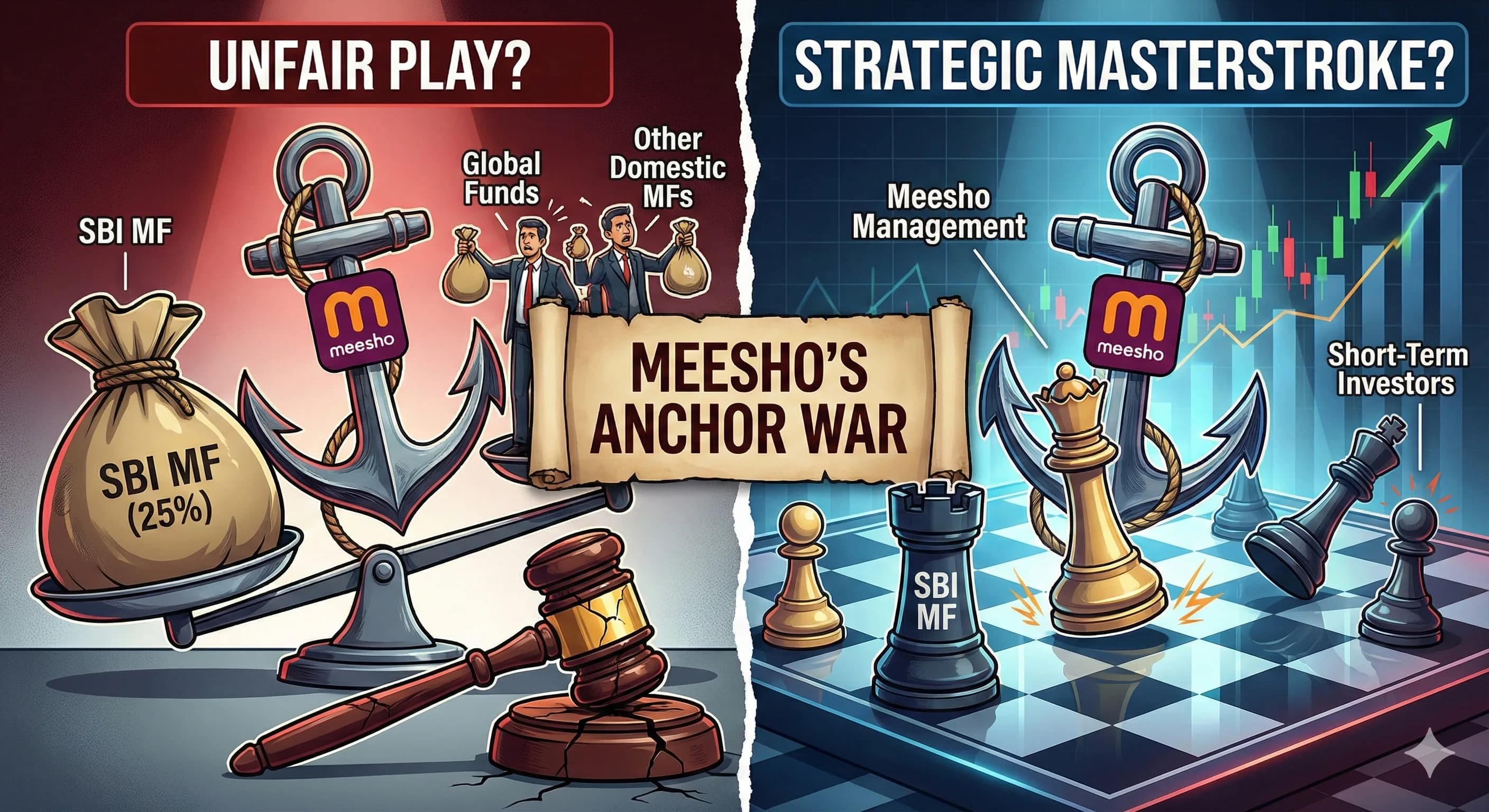
Meesho’s Anchor War: Unfair Play or Strategic Masterstroke?
In the high-stakes world of IPOs, the "Anchor Book" is supposed to be a quiet, confidence-building prelude. But for Meesho, the SoftBank-backed e-commerce giant, it turned into a battlefield. On the eve of its massive ₹5,421 Crore IPO, a rare and public rift erupted between the company and some of the world’s largest institutional investors.
At the heart of the storm is a bold, controversial decision by Meesho’s management: to allocate a disproportionate 25% of the entire anchor book (approx. ₹603 Crore) to a single domestic giant, SBI Mutual Fund.
This move, which reportedly overruled the advice of investment bankers, led to a mass exodus of marquee investors like Capital Group, Norges Bank, and ICICI Prudential, who walked out in protest. Is this a case of poor corporate governance, or is Meesho rewriting the rules of how "New-Age" tech IPOs find stability? Let’s dive deep.
🔥 The Controversy Explained
- The Trigger: Meesho allocated ~₹600 Cr to SBI MF, while offering significantly less (~₹100 Cr) to peers like ICICI Pru.
- The Reaction: Feeling slighted by the "yawning gap," major funds opted out entirely.
- The Result: A split anchor book dominated by SBI MF, GIC, and Fidelity, with key domestic players missing.
1. The "Fairness" Debate: What Upset the Big Guns?
Institutional investors operate on unwritten rules of hierarchy and "fair play." When a company opens its anchor book, allocations are typically distributed to ensure a diverse mix of long-term backers. By tilting the scales so heavily toward SBI MF, Meesho disrupted this equilibrium.
The "Precedent" Fear
For funds like ICICI Prudential and Nippon India, accepting a "token" allocation of ₹100 Crore—while a peer got ₹600 Crore—wasn't just about money; it was about status. A senior executive noted that accepting such a disparity would set a dangerous precedent, signaling that they are "second-tier" investors compared to SBI MF.
"The absence of a framework for 'fairness' in anchor allocation leaves room for subjective judgments... creating multi-sided disagreement." — Market Source
2. The Counter-Argument: Why Meesho Chose SBI MF
Why would Meesho risk alienating global giants for one mutual fund? The answer lies in the volatile history of tech IPOs in India (think Paytm or Zomato). Meesho prioritised commitment over optics.
- Early Commitment: Sources reveal that SBI MF engaged with Meesho months in advance, committing to price and quantity long before the book opened. They weren't just "window shopping"; they were buying the vision.
- Price Discipline: SBI MF reportedly agreed to be a buyer not just in the anchor round, but also in the main book and post-listing, even if the stock dips. This "stabilizing" role is what a true Anchor is defined by.
- The "Tourist" Investor Problem: Many funds treat IPO anchor books as a quick trade—getting in early and dumping stock once the 30-day lock-in ends. Meesho likely viewed SBI MF as a "long-term partner" versus others who might be "fair-weather friends."
3. IPO Details: The Numbers You Need
Despite the noise, the IPO is open and fully active. Here are the critical details for retail investors:
| Metric | Details |
|---|---|
| Issue Dates | Dec 3 – Dec 5, 2025 |
| Price Band | ₹105 – ₹111 per share |
| Total Issue Size | ₹5,421 Cr (Fresh: ₹4,250 Cr | OFS: ₹1,171 Cr) |
| Valuation | ~₹50,096 Cr ($6 Billion) |
4. The "Anchor" Role: Is It Broken?
This controversy exposes a flaw in the Indian IPO system. The term "Anchor Investor" implies stability, yet the allocation process is opaque. Currently, SEBI regulations mandate lock-ins (50% for 30 days, 50% for 90 days), but they do not dictate how shares should be distributed.
The Transparency Gap: Unlike the "Net Offer" which has strict quotas for QIBs, NIIs, and Retail, the Anchor book is discretionary. Promoters and bankers have free rein. Meesho’s move, while aggressive, was fully legal. It simply violated the "gentleman's agreement" of distributing the pie equally.
5. What Does This Mean for Retail Investors?
Should you be worried that big names walked out? Not necessarily. Here is why:
✅ The Bull Case
The fact that SBI MF—India's largest fund house known for conservative bets—is willing to put ₹600 Cr into a loss-making tech stock is a massive vote of confidence in Meesho's turnaround story.
⚠️ The Cautionary Note
The exit of foreign funds like Capital Group and Norges Bank reduces the diversity of the shareholder base. If sentiment turns sour, having fewer large backers could increase volatility.
Final Verdict: Strategy Over Ego
Meesho’s management has made a high-stakes gamble. By favoring a committed long-term partner over a broad list of "prestige" investors, they have prioritized stock stability over market popularity.
🛡️ MoneyDock Takeaway
- Don't Panic: The "walkout" was an ego clash over allocation size, not a red flag on the business fundamentals.
- Follow the Leader: SBI MF's track record in tech (Zomato, PB Fintech) has been solid. Their heavy conviction is a positive signal.
- Watch the GMP: Despite the drama, the Grey Market Premium remains steady, indicating that retail demand is unaffected by institutional infighting.
Disclaimer: This article is for educational purposes only. I am not a SEBI registered investment advisor. Please consult your financial advisor before investing.
Share this article
Try These Calculators
Fixed Deposit (FD)
Calculate the maturity amount and interest earned on Fixed Deposits.
Recurring Deposit (RD)
Plan your savings with estimates for Recurring Deposit maturity values.
PPF Calculator
Calculate returns and maturity value for your Public Provident Fund.
Senior Citizen Savings (SCSS)
Estimate quarterly interest earnings for Senior Citizen Savings Scheme.