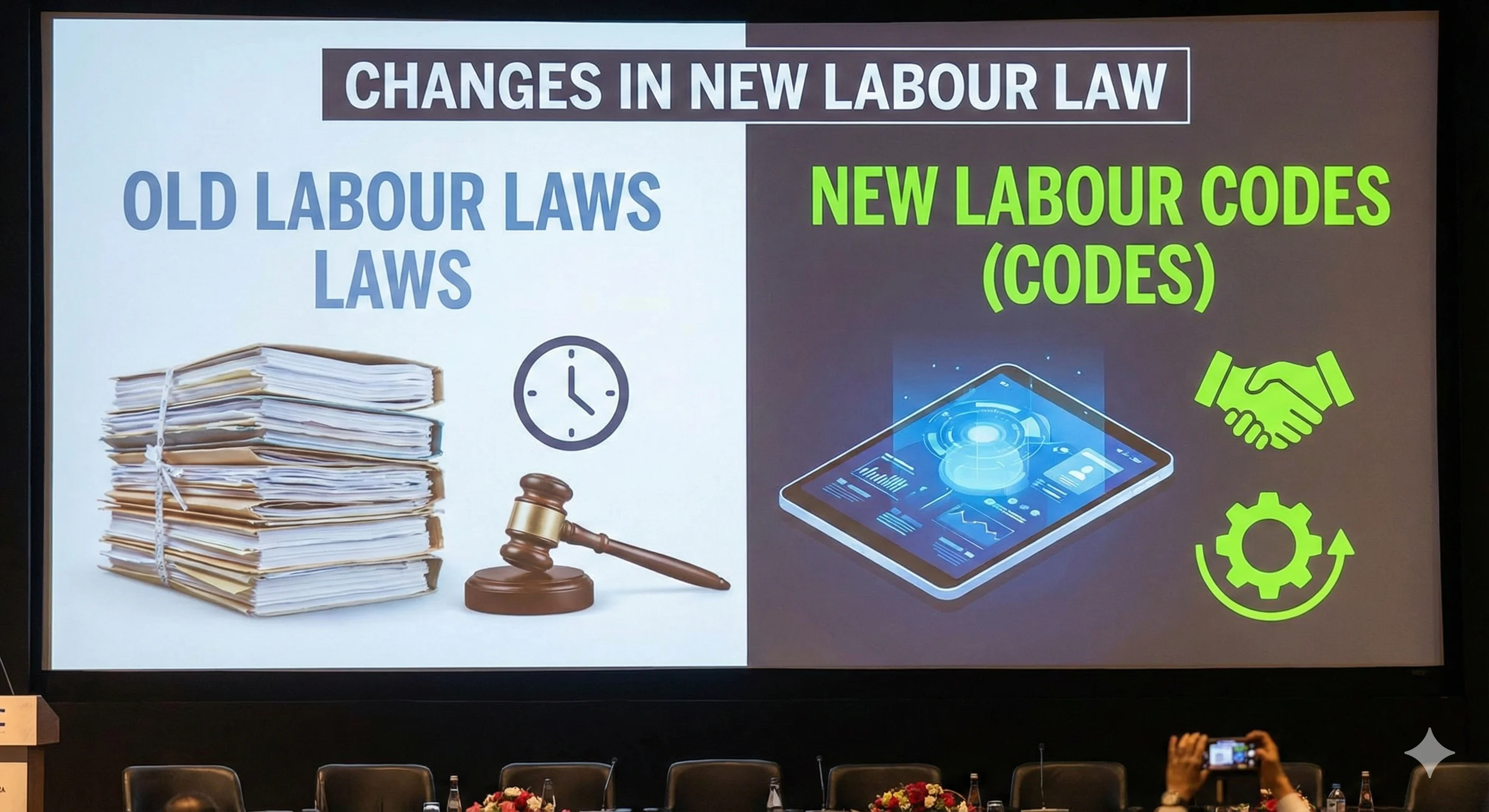
New Labour Laws 2025: Top 10 Changes
If your salary slip looks different or your HR is talking about new policies, you aren't alone. As of November 21, 2025, India has officially operationalized the four new Labour Codes—a massive overhaul replacing 29 outdated laws.
Whether you are a fresh graduate, a gig worker, or a seasoned corporate employee, these rules change how you work, save, and get paid. Here are the top 10 most important changes you need to know.
1. The "50% Basic Pay" Rule (Your Take-Home Might Drop)
This is the biggest financial change. The new Code on Wages mandates that your Basic Salary must be at least 50% of your total Cost to Company (CTC).
- The Impact: If your basic pay was low (to keep allowances high), your employer must now increase it.
- The Result: Since Provident Fund (PF) and Gratuity are calculated on Basic Pay, your PF contribution will go up. This means your monthly take-home cash may decrease, but your retirement savings will grow significantly faster.
2. The 4-Day Work Week Option
The new codes allow flexibility in working hours. Companies can now offer a 4-day work week, provided the total weekly hours remain at 48 hours.
- The Catch: To get 3 days off, you will have to work 12 hours per day for the remaining 4 days. This is optional and depends on an agreement between you and your employer.
3. Gratuity in Just 1 Year
Previously, you had to work for a company for 5 continuous years to be eligible for Gratuity (a cash benefit paid when you leave a job).
- The Change: For fixed-term employees (contractual staff hired for a specific period), gratuity is now payable after just 1 year of service.
- Note: For regular permanent employees, the 5-year rule generally still applies, though this is a developing area in state-specific rules.
4. Social Security for Gig & Platform Workers
For the first time, laws legally recognize "gig workers" (like Uber/Ola drivers, Zomato/Swiggy delivery partners, and freelancers).
- The Benefit: A special social security fund is being created. Aggregators (the apps) must contribute 1-2% of their annual turnover to this fund, which will provide health and maternity benefits to gig workers.
5. Earn Leaves Faster (180 Days Rule)
Getting paid leave just got easier. Under the old rules, you had to work 240 days in a year to be eligible for leave encashment or earned leave in the next year.
- The Change: This threshold has been reduced to 180 days. You qualify for leave benefits sooner.
6. Women Can Work Night Shifts (Legally)
The Occupational Safety Code removes restrictions on women working at night.
- The Condition: Women can work shifts between 7 PM and 6 AM, but it is strictly voluntary. Employers must ensure adequate safety, working conditions, and transportation for female employees working these hours.
7. Universal Minimum Wage
Previously, minimum wage laws only applied to specific "scheduled" jobs (mostly factories and construction).
- The Change: The new codes introduce a National Floor Wage. No employee in any sector (organized or unorganized) can be paid less than this floor wage fixed by the Central Government.
8. "One Nation, One License" for Companies
This is a relief for employers and startups. Instead of registering for multiple laws (PF, ESI, Contract Labour, etc.) separately, companies can now use a single integrated license.
- Why it matters to you: Less paperwork for companies theoretically means faster hiring and easier compliance with your benefits.
9. Reskilling Fund for Laid-Off Employees
The Industrial Relations Code introduces a safety net for those who lose their jobs.
- The Benefit: Companies must contribute 15 days of the retrenched worker's last drawn wages into a "Reskilling Fund." This money is directly credited to the worker to help them learn new skills while looking for a new job.
10. Easier Compliance (End of "Inspector Raj")
The role of the Labour Inspector has been changed to "Inspector-cum-Facilitator."
- The Change: Inspections will now be web-based and randomized to prevent harassment. Officials are tasked with helping companies follow the law rather than just penalizing them, which should encourage more companies to formalize their workforce.
Summary: Is this Good or Bad?
- The Good: Better retirement savings (PF), legal recognition for gig workers, and better safety for women.
- The Tough: Your monthly cash-in-hand might shrink due to higher PF deductions, and a 4-day work week (if chosen) means grueling 12-hour shifts.
Action Item: Check your next payslip closely. If your Basic Salary has suddenly jumped to 50% of your total income, your company has already adopted the new Code on Wages!
Share this article
Try These Calculators
SIP Calculator
Calculate the future value of your monthly Systematic Investment Plans.
Personal Loan EMI
Compute the Equated Monthly Installment for personal or car loans.
Income Tax Estimator
Quickly estimate your tax liability under the Old vs New Tax Regimes.
Inflation Calculator
Understand how inflation erodes the purchasing power of your money.